Tuesday, November 25, 2014

Saint Demetrios

There is a phenomenon known as the “Holy Week of St. Demetrios,” which is where they take the hymnography of Holy Week and adapt it to St. Demetrios, including an epitaphios service with encomia (aka praises, "lamentations") two nights before the Feast. It really felt like Holy Week this year because the Feast fell on Sunday. With Fr. Spyro’s blessing I went to as many things at St. Demetrios Church that week as I could. They do Orthros at 6:30 pm, with a three-ode Canon based on one of the Canons of Holy Week. Then follows the Paraklesis to the Panagia. After a short break, a vigil begins at 9:00 pm, the content of which varied by night. Mostly it was Vespers, Orthros, and Liturgy. One day they threw Paraklesis in there. Another day it was just Orthros and Liturgy. The vigils were generally well attended, some more than others. But there were always people. In the morning they did Orthros and Liturgy again. I never went to any morning Liturgies there because I have class every day.

Each year St. Demetrios is co-celebrated with a wonderworking Icon of the Panagia. In 2012 it was the Axion Estin (It is truly right) Icon from Mt. Athos, and the lines were out the door (I was in Thessaloniki from Oct 26-28 that year). This year they brought an Icon I had never heard of, Panagia Triphotissa from Ainon of eastern Thrace. I don’t know where that is, that’s just what it said in all the literature. In any case it was a great blessing to get to venerate both her and St. Demetrios every day that week.

I was torn where to go to church on October 26, the Feast Day of St. Demetrios. Half of me wanted to avoid the crowds and go to St. Haralambos (where there are always a lot of people on Sundays and Feast days, but not like at St. Demetrios on the Feast!). But what persuaded me to go to St. Demetrios that day was that I knew people would ask me something along the lines of, “Oh, you were in Thessaloniki. Were you there on October 26 for St. Demetrios? You were?! Did you go to his church on his Feast Day?” How anticlimactic it would be for me to say, “No, there were too many people.” How lame would that be! Now I went, I had the experience; and if I’m ever in Thessaloniki again for that Feast day, I will probably go to St. Haralambos, or somewhere else where there might be just a few fewer people. Fourteen bishops concelebrated at St. Demetrios, along with ten priests and four deacons (countless others were in attendance though).

Fourteen bishops. Metropolitan Anthimos of Thessaloniki was the main celebrant.
I got there after the Six Psalms, around 6:45 am or so (they started at 6:30). There were already a number of people there but I was able to find a place to stand right behind the roped-off area where the important people were to stand. It gradually filled up around me until I could hardly move.
For those of you liturgical nerds out there who know the set-up of Matins/Orthros, you may know that the practice of the Ecumenical Patriarchate is to switch the Orthros Gospel from its normal place before the Canon, to be read after the eighth ode instead, before More honorable than the cherubim. This so that the bishop can listen to and venerate the Gospel when he comes in at the Katavasies, and also so that the people who come to church late can hear the Gospel as well. The Church of Greece has largely corrected this and put the Gospel back at its proper place. However that day they did the inverted order. The bishop came after the canon and began the Katavasiae, then they read the Gospel, brought it out for him to venerate, and then brought out TWO Gospel books for the people to venerate! I think that was pretty smart. The church was not packed like sardines yet, but there were still a lot of people - definitely way more people than any church in America would have at Communion time on a normal Sunday, but still not nearly full!
Two Gospel books for veneration at Orthros
The veneration of the two Gospel books lasted through the 50th psalm, through the deacon’s petition O God, Save Thy People, and halfway through More honorable than the Cherubim, at which point one priest took his Gospel to the back of the church to place on a stand for veneration by late-comers (as is the normal Greek parish practice), and the other priest took his Gospel book back into the Altar. I’m also sure that not everyone venerated because there were people upstairs in the balconies, as well as those who were in the line to venerate St. Demetrios. That gives you an idea of how many people were there at that time, and that was when you could still move around in the church. Later on, forget it (see next paragraph).
This gives you some idea of how many people there were.


More people in the balconies

All the important political/military people. I was right behind them.

Communion was interesting, to say the least. There were no chalices on the solea, because that’s where everyone was still in line to venerate the Panagia and St. Demetrios. They had instead multiple chalices at the front of the side aisles of the church, and even one in the courtyard! It was chaos getting up there. Someone accidentally knocked over the icon of the Panagia weeping at the foot of the Cross (there is a free-standing crucifix with the Panagia and St. John the Theologian on the left side of the church). Most of the clergy distributing Communion were not the ones who had concelebrated at the Liturgy, but those who had communed, put on an epitrachili (stole), and had the chalices to commune people. I think that was very smart, because the official “Communion time” during the Liturgy lasted for about a minute, and then they continued the Liturgy while the non-celebrating priests and deacons communed people on the sides of the church. I communed long after the Liturgy had finished.
The daily vigils and morning Liturgies are celebrated each day for two whole weeks – one week before the feast and one week after. This culminates with the Ἀκολουθία τοῦ καθαγιασμοῦ τοῦ μύρου τοῦ Ἁγίου Δημητρίου – the service of the sanctification of the myrrh of Saint Demetrios. This takes place one week after the Feast. The church was packed full of people who all wanted to see what was happening. The Metropolitan of Thessaloniki was there along with a ton of priests. They did a short 30-minute Vespers, and then the metropolitan talked and then began the service where there were basically some prayers, and then the choirs chanted the megalynaria from St. Demetrios’s Paraklesis (the hymns chanted at the end, after It is truly right). They repeated the megalynaria many times because it was during that time that the clergy opened the reliquary and (from the very little that I could see) rubbed cotton on the bones of the Saint to absorb the myrrh that he exhudes. Then they brought out two giant bowls of man-made myrrh which they use to make it go farther – somehow they mix the myrrh of St. Demetrios with the man-made myrrh and put it onto cotton balls to give to the faithful. It’s something to be proud of if you have connections and can get a cotton swab with only the myrrh straight from the Saint’s relics on it. I don’t...

The bishop, priests, and a bunch of people crowding around the relics during the myrrh service.
After the conclusion of this service one of the priests began Orthros immediately, and another priest interrupted the Six Psalms to announce that there were going to be ten priests distributing the myrrh, five on each side of the church (if I remember correctly), and to ask everyone to remain calm and orderly. Orthros lasted about an hour and people were going steadily to receive myrrh from the priests. They stopped distributing when Liturgy started. I didn’t realize that so I didn’t get any myrrh, because I was waiting until the line died down. Right before Communion a random young man stopped me and said (in Greek), “did you get myrrh?” I told him no and he pulled a small plastic pouch with a cotton ball out of his pocket and gave it to me. I asked him how he knew me and I forget what he told me (it was something that made sense – mutual friends. We had met somewhere before), but I did not remember him at all. That was very providential!


Last week I was talking on Google chat with one of my former professors from HC/HC and I was telling him a little bit of the above information about St. Demetrios (whom he loves). He was asking about the lines to venerate the relics. From what I could tell there was a pretty steady line during the early evening hours, during either Vespers or that “Bridegroom Matins-ish” service the week before the feast. During the vigil it was not as long and I could go during Orthros or Liturgy to venerate and not wait in line. I don’t know what the morning services were like, or what it was like during the day, but there were quite a few people venerating St. Demetrios and Panagia Triphotissa for two whole weeks! It’s pretty awesome! And on the Feast day you could wait several hours to venerate (I’m guessing), in a very long line - I got there before 7am and only waited 15 minutes. This professor told me he wanted to co-author a book with one of the other professors, about "cities, liturgies, and St. Demetrios." J

Monday, November 17, 2014

Greece 2014 so far (November 14)

Thessaloniki 2014 so far

Written on November 14, 2014

I know it’s been a ridiculously long time since I’ve blogged – I haven’t written anything since the last time I came to Greece in 2012 but here is a summary of my last month and a half here. I got to Thessaloniki on September 30th. You know things are bad when the Germans are on strike – the strongest nation in the EU. Well, my flight through Germany on Lufthansa was canceled, and my travel agent was very helpful and found a way for me to get on Turkish Airlines and go through Istanbul. I was in the middle of the plane, and in the four seats behind me were four people whom I ended up talking to: three priest-monks from the Monastery of Giromeriou (Μονή Γηρομερίου)(http://www.monigiromeriou.gr/) near Igoumenitsa (Ηγουμενίτσα), on the mainland across from Kerkyra (Corfu). One of them was the abbot, and the other two were monks of the monastery, one who lives there and another who is attached but is the preacher in the Metropolis of Katerini outside Thessaloniki. The fourth person was a layman who is a friend of the monastery and I believe he was from America but has lived in Greece for a long time. I talked with the abbot quite a bit (we sat next to each other on the plane from Istanbul to Thessaloniki), and hung out with the three fathers and their friend in the Istanbul airport during our layover. I have their contact information and hopefully will see them again, either visiting their monastery or when they pass through Thessalonica. See how God works? It was really providential that I got put on that flight. I’m very happy to have met them, and really hope I get to see them again.

With the three fathers and their friend, in the Istanbul airport during our layover.
We landed around 8:00 pm. My cousin met me at the airport and we took a taxi to the place where I am living, a building with very small individual rooms, for international students, about a fifteen minute walk from the center of Thessaloniki. The place provides sheets, that’s about it. So once I met the owners (who had come there because I had been in touch with them and told them my arrival time – they’re usually only there in the morning) and chose which room I wanted, I had to walk downtown to buy some basic things: soap and toilet paper. I probably could have found them close by but I didn’t know the area and I didn’t want to walk around a strange neighborhood by myself at night. So I went downtown. I went to bed late that night and it took a few days to get adjusted from the jetlag.
In the beginning I was going every day to St. Haralambos, the metochi (dependency) of Simonopetra in Thessaloniki. I blogged about it last time. It’s a really nice little church and I had gone there a lot during the month I spent in Thessaloniki in 2012. Right now the married priest who serves there (Fr. Athanasios) is on sabbatical (he’s also a university professor) so guess who’s filling in? Fr. Iakovos, the one and only. There’s a Greek expression, “πάντα μπροστά μου εἶσαι” (lit. "you're always in front of me") or something like that, which basically means that you see someone everywhere. I met Fr. Iakovos in Boston, then I saw him at Simonopetra in 2012 when I went, and then he was in Boston again last year. Now he’s here in Thessaloniki!

Before classes started I really had nothing to do and I was quite bored. Now the pace of things has picked up, I am plenty busy, and I am still going very frequently to St. Haralambos but am also going to the church in my neighborhood, Dormition of the Theotokos, which is closer and easier to get to on some weekdays. I have class 8:30 am until 12:00 noon every day, and I have started my ambitious translation of the Typikon of George Rigas, a 900-page book that is quite awesome, and way more detailed (and more accurate in some places) than the Typikon of Violakes, which is the official typikon of the Ecumenical Patriarchate. I’m not the only one who likes Rigas, but unfortunately we are in the minority. (St. Nicholas Planas was reported to say, “by obedience the new (calendar), but by conviction the old!” I would like to modify that to say “By obedience Violakes but by conviction Rigas!” In other words, I am obedient to the Patriarchate and use Violakes even if I don’t like it, but I really wish we could use Rigas!) I’m not trying to start a revolution, however. Hopefully if this translation of mine ever gets finished (I’ve done about  30 pages so far), it will be primarily an academic reference tool, although most academics who would be interested in typikon would probably be able to read it in Greek. It’s also a great chance for me to practice my Greek…I have learned quite a few new words, as well as really interesting details about the services, including different Greek names for the various Litanies (συναπτές, ἐκτενή, δέησις), whereas in English we just call them Litanies or ektenias or something like that, but in Greek each has a specific meaning (at least for Rigas. I’m pretty sure it’s more common).

I’m also trying to excel in Byzantine music. I know the 95% of the prosomia, and I can generally chant idiomela if I practice them (unfortunately I mostly sight-read them in church and therefore make more mistakes than I would like). My real difficulty however is the papadic genre, i.e. slower pieces chanted during the Divine Liturgy: the Cherubic Hymn, It is truly right, and the Communion hymn. It’s my short-term goal to learn at least one Cherubic Hymn and It is truly right in each mode, as well as (kind of ambitious) a Communion hymn for each day of the week, in each mode. That’ll take awhile. I bought a nice little book that has short Communion hymns in the eight modes that aren’t too hard. I’ve learned one and a half so far ;) I also bought a big book called Mousike Pandekte, volume 4, which has pretty much anything you could want for the Divine Liturgy (it’s 878 pages, 373 of which are just Cherubic Hymns...that gives you an idea of how detailed it is). It’s kind of cumbersome to carry with you to church, but it’s what is being used in the music class I’m taking at a church here, and my teacher in Boston recommended it as being good for practice. So, σιγά-σιγά. I want to be able to chant the Liturgy in any mode at the drop of a hat – a little ambitious, and baby steps will get me there (such as learning a Cherubic hymn in each mode first). It’s rare that I’m placed first at a Liturgy and am asked to chant the Cherubic hymn and/or It is truly right, but when it happens I want to be prepared – it happened the other day for instance. I was the only person who knew music, surrounded by three older men and a young guy, all of whom knew the order of the service very well, plus some basic things, but nothing complicated about music. I wasn’t prepared but I chanted the Liturgy in first mode (this week is plagal first) and it went ok. I want to be able to do that in every mode, and not to go “ok,” but “great.” Σιγά σιγά. My next goal is to learn a Cherubic hymn in plagal 2nd for next week, and to keep working on those short Communion hymns in that little book, particularly the ones in plagal 2nd.

On Monday nights I go to a Byzantine music lesson from 7:00-9:00 at Panagia Laodigitria. I am going to start going from 5:30 because in that class they are finishing the slow heirmologion and starting slow Doxologies, things that I studied in Boston but am nowhere near a master of. It’ll help, I hope. The 7:00 class is Liturgy stuff, so it’s right up my alley also! These lessons are down the street from the Panagia Laodigitria church, in the parish center, a multi-storey building. On the roof they have a little chapel to the New Martyr Alexander (I don’t know anything about him). At 9:00, after the music class finishes, they do Small Compline in there, and in the middle (instead of reading the Akathist) they chant the Paraklesis to the Theotokos, but only the canon (the “heart” of the Paraklesis), so that it takes about fifteen minutes, plus fifteen minutes of Compline, comes to half an hour altogether. At 9:30 one of the priests (Fr. Barnabas) gives a talk in an auditorium in the same building. The auditorium is full of young people every week. It’s impossible to find a seat, and most of the time I stand against the back wall. The talk goes until 10:30. I have met quite a few nice people there at Panagia Laodigitria, people around my age, and I hope to deepen our relationships and become friends with them through continuing to go to music lessons and talks. I also see some of them around at random things in other parts of the city, so it gives another setting as a background for a friendship.

On Thursday nights I go to a much more low-key talk at Panagia Acheiropoietos in the center of town, with Fr. Spyro. There are about 20-30 people every week. A lot of Americans go to that but Fr. Spyro talks in very simple Greek (with the occasional translated word or phrase) so it is helpful for us! I take notes when I go to talks, and my notes are half in Greek and half in English. It’s kind of funny for someone to look at my notebook if they’re not used to it. J

Oh, and…yes, I am learning Greek. Slowly. Equally as important as are the classes, I need to make sure I spend time with Greeks and not with Americans, so that I can learn slang and other informal things, as well as getting comfortable practicing what I learn in class. I also should probably try to read some Greek books. Now, however, on the rare occasion when I make time to read, it’s usually in English (unless it’s music or the Rigas typikon…).

That’s basically my life in a nutshell. I wrote it on the train between Thessaloniki and Athens because that’s the only time that I can get on my computer and not be distracted by internet. Otherwise I don’t find any time to blog, even though I know I should and people want to know how I’m doing. Forgive me.


(I am hopefully going to blog about my trip to Athens another time. I went there for the weekend, and now it is Monday and I am back in Thessaloniki, but this blog was written Friday on the train, as I mentioned.).

Sunday, June 17, 2012

Impressions of Greece (June 2012)


Έυκολο (Easy). People keep asking me how I like Thessaloniki «Πως φαίνετε η πόλη;» (not sure if my Greek spelling is correct). I keep telling them that it’s nice, and really easy! I’ve lived in Boston (granted, not downtown) for almost two years. As of right now (June 14, 5:02 pm) I’ve lived here for six days. I understand Thessaloniki better than I understand Boston.
When I was at my aunt’s apartment, I opened my computer and got on their WiFi. My cousin (their nephew) was showing me the city on Google Maps – St. Demetrios, Panagia Dexia, thia’s apartment, his apartment, my yiayia’s apartment, Three Hierarchs, St. Photios, etc. He then went on the public transit website, gave the the rundown on prices here, and told me which buses I could take from close to my yiayia’s house to go to the center of town. I felt that I had a pretty good sense of the city, at least a basic idea of it. Now after almost one week I feel that I know the city very well, especially after having gone into the κέντρο each day and seeing things. If I get lost on a back street somewhere I pull out my trusty little tourist’s map that my friend helped me get at a little stand here.
As far as Boston goes, I understand the T (public transit) very well. I can take the T anywhere I need to go, if I know exactly where I’m going. As for the city itself, I guess since I live outside of it and don’t go in it very much, I don’t have a good sense of anything. It doesn’t help that all the roads around school curve this way and that, and that you seemingly can’t get anywhere unless you have a GPS or you’ve been there 100 times (like Holy Resurrection).
Boston (to me, at least) is a difficult city. Thessaloniki is extremely easy.

Albanian?! I was in my yiayia’s apartment, sitting down (I may have been blogging). It was a day when they have the λαϊκή αγορά, which is when vendors line a street and sell all kinds of things. The λαϊκή αγορά had finished and there were people outside cleaning up. I randomly heard someone say pretty loudly, “Mirupafshim! Falemenderit! Falemenderit!” That is Albanian for “Goodbye! Thank you! Thank you!”
Another time I was walking into a bank. They have these doors here (Idk if it’s for security or what). You press a button, open a door, let it close behind you, and then press a button to open a second door and enter the bank. I was waiting in a short line to open the first door. The woman in front of me was on her cell phone. I don’t remember what she said but I think it sounded like Albanian.
I know that Albania and Greece are neighbors, and that the Albanians and the Greeks are cousins, as much as they don’t want to admit it. Yet somehow, in public you expect to hear Greek, a little English, and the occasional other language. I don’t know how many other languages there are but it’s a pretty low probability that you’ll hear Albanian when you weigh it with all the other possible languages! It’s funny, having just come from there and knowing 20 words of the language, to hear it in another country – I don’t expect it! J

A monastery or a parish? How about neither? The second day I was here my cousin took me to his church, St. Haralambos. It is a metochion of the Athonite Monastery of Simonopetra. Its main purpose, from what I can tell, is so that when fathers from the monastery visit Thessaloniki they have some cells around the church that they can stay in – it’s sort of like a half-monastery that is a haven for them.
At St. Haralambos they commemorate the Patriarch of Constantinople, as on Mount Athos, not the Metropolitan of Thessaloniki. They also pray for the abbot (Hieromonk Elissaeus), and for “this monastery,” rather than “this church.” St. Haralambos is serviced by Fr. Athanasios, a married priest. There is a core group of people that go there regularly, yet it is not a parish. It’s not a monastery either. It’s kind of in the middle.
At St. Haralambos they do Vespers every day except Sunday, as well as Divine Liturgy four times a week (Sunday/Tuesday/Thursday/Saturday), much like the Nativity of the Theotokos Monastery near Pittsburgh. On Tuesday evening they do a Paraklesis to St. Haralambos following Vespers, and on Wednesday evening they append Thursday morning’s Orthros – a total length of 90 minutes for both services. Thursday morning they begin at 6am with the Hours and the Divine Liturgy. It’s more “monastic” to do Liturgy earlier, and from what I understand they also do that for people who work early and want to go to Liturgy before work.

Culture clash. There exists the traditional Greek culture of Orthodoxy. When I walk from my dorm room to St. Haralambos for Liturgy or for daily Vespers, I pass five other churches, at least three of which are doing a service around the same time. There are little προσκηνιτάρια (little church-looking things with icons and candles) outside every church, which are open 24/7. People stop inside, light a candle, do their cross as they pass the church, and move on. Whoever actually goes to church, goes to Confession, and receives Communion is another story. But the culture is such that it’s natural to see a robed, long-bearded priest crossing the street with an imposing Byzantine-style church on one side and a “Sex Shop” (they exist, unfortunately) on the other. It’s also natural for people on the bus to cross themselves as they pass a church. Do they ever go inside? I don't know.
I’m not sure how I feel about this. On the one hand I like how the Church is there as an expected presence in the modern culture. On the other hand what that modern culture is, and how it clashes with the Church, I’m not the biggest fan of. It’s interesting.

Three Hierarchs. Would there be somewhere in Greece (besides Starbucks) that reminds you of America? Probably not, especially when you’re in the Church. Usually it’s the other way around. A particular parish in America reminds you of Greece, not Greece of America. However, I experienced a parish that reminded me of a parish in America that reminds me of Greece. Confused? Let me explain.
When I got here and my cousin was showing me the city on Google maps, he told me where to get off to go to my yiayia’s apartment. It is the stop right next to the Three Hierarchs church, which is a five minute walk from the apartment. Since I got here on Friday and didn’t get to go to Liturgy Friday night in the crypt of St. Demetrios, I wanted to go on Saturday morning. Nearly every parish here does Liturgy on Saturday so I had an infinite number of options. I wanted to go somewhere closeby where I would know where to go and not get lost. I decided to do the five minute walk to Three Hierarchs because it seemed to be the closest.
It is a beautiful, absolutely stunning church – huge, with magnificent architecture and iconography. I will post pictures when I get a chance! After Liturgy I met two of the priests (they have four), both of whom know my yiayia who goes there sometimes even though that isn’t her parish. They had a pretty good turnout for a “normal” Saturday Liturgy! I asked for a schedule of services and noticed that they were doing a vigil on Sunday night for ‘Όσιος Βαρνάβας. I know that the Apostles Bartholomew and Barnabas celebrated on Monday but ‘Όσιος is not usually used for apostles. I decided to go and check it out.
Sunday night I ate with my yiayia and then headed out on foot for the Three Hierarchs. I got there at Φως ‘Ήλαρων. One priest was serving – neither of the two that I had met on Saturday. His face was a bit like that of Fr. Ignatios, a retired priestmonk who used to live in Pittsburgh. The vigil went rather quickly – it didn’t drag on with lots of things, but it was basically a typical Vespers, a typical Orthros, and a typical Liturgy put together. Nothing extra.
I was soooo glad I went! The entire service was amazing! (The chanting was average). The lights were dim. The priest said the silent prayers of the Liturgy out loud, which you rarely hear done in Greek. For some reason (I don’t know how) the vigil reminded me of vigils at St. John’s church in Boston (http://www.saintjohnthebaptist.org/) where Fr. Dragas serves and Menios (our Byzantine music professor) chants for vigils (used to be his parish before he became our full-time professor). St. John’s is one of those churches that reminds you of Greece. However, since I knew St. John’s before I knew Three Hierarchs, Three Hierarchs reminds me of St. Johns! J It had something to do with the big church, the Greek, the relatively small amount of people (still a good number, but not packed!)… Idk. The chanting wasn’t as good, it wasn’t Fr. Dragas, and they didn’t do all the things they would have done at St. John’s. But somehow it reminded me of being there. I felt at home. I was very glad I went and hope to go back, although now living in the center Three Hierarchs is far. Oh well, I’ll find a time to go back J I also want to meet the priest. I got his blessing after Liturgy (they also had a relic of ‘Όσιος Βαρνάβας, an ascetic from Cyprus) but didn’t introduce myself. He seems very awesome J

Meals. No wonder people here aren’t as fat! They eat one or two big meals a day – not three! We have to have a nice, big breakfast to “get us started” and “get the blood pumping.” Then we need to “keep ourselves going” with a nice big meat-filled lunch. Then we end the day with a really big dinner. Here they drink water and coffee in the morning, and they might have a κουλούρι and/or a piece of fruit to hold them over until the big meal which is usually around 1-2pm. For dinner they’ll eat a medium-sized, healthy meal that will satisfy the built-up appetite but that won’t weigh them down. Many people also sleep after lunch, because that is the hottest part of the day. That way they are able to do more later at night and earlier in the morning when it is cooler, because they are sleeping less at night and napping during the hottest part of the day.
What I just described is very over-stereotypical. There exist fat people here, and some people I’m sure eat three big meals, many don’t nap, and many do something different from any of the above. In general, though, there are one to two big meals and people are healthier. I’ve also noticed that if you eat a small amount in the morning, you only get hungry around midday when it’s time for lunch. You’re not hungry the whole morning like you would think. It works. Very interesting! J

Garbage. I noticed a lot more of this in Albania (creeks filled with plastic bags and the like) but even here in Greece there are a lot of dumpsters on side streets that are overflowing, and a lot of little pieces of garbage floating around the streets. In Albania they didn’t recycle. Here they recycle in name, but how many actually do is a different story. I don’t know. Nathan told me in Albania “they don’t even put them [bottles] in the trash! Why would they put them in recycling?!”

Greek or English? I noticed what I thought were English letters on a license plate. When I looked closer I noticed that it was something like AKP, which could be either Greek or English. That made me wonder if the license plates here are in Greek or in English, since Greece is in the European Union. I started looking, and noticed the ingenious fact that all the license plate letters could be letters in either language, depending on how you look at them. Letters such as C, F, G, J, L, Q, R, S, U, V, W, Γ, Δ, Θ, Λ, Ξ, Π, Σ, Φ, Ψ, Ω are not used. Only A, B, E, H, I, K, M, N, O, P, T, X, Y, Z which exist in both alphabets. That way they can be registered with the European Union in Latin letters, but non-English-speaking Greeks can have Greek license plates. This is my personal conjecture/observation but it makes sense and is a wonderful idea!

Thursday, June 14, 2012

Friday, June 8, 2012

Friday, June 8, 2012
I woke up at 3:30 am and took a shower. I got all of my stuffy ready, sent a quick “leaving Tirana now” email to some family members and close friends, and ran downstairs to the van with all my stuff. I sat in the front seat and didn’t put all my stuff in the back with everyone else’s. Theodhori had told the van driver where to go to drop me off, and when we got there Fr. Luke helped me meet the guy who sold me my ticket. He didn’t speak Greek, but he did speak English, thankfully :) I said goodbye to Fr. Luke and then the rest of the group was off to the airport! I went into the office and payed for my ticket (25 euro=3500 lek), then the guy (who was very nice) told me which bus to get on. I ran down the street and grabbed a breakfast sandwich from a little restaurant and then went back on the bus.
We pulled out (unexpectedly to me) a few minutes before 5:00. We were off on various roads in the general direction of “Selanik,” as the Albanians call Thessaloniki. I knew that Thessaloniki was southeast of Tirana, and at one point it looked like we were going west (the sun behind us). I was all alone, with no cell phone, and didn’t speak the country’s language. I kept having doubts, and fears that this was going to Moscow, Kiev, Paris or London or something, or that I got on the wrong bus, or something to that extent. I was also worried that at some point I would have to change buses and wouldn’t know that and would end up in Athens, or back in Tirana or something.
I got up the courage to ask a gentleman who was sitting across the aisle from me: “Κύριε, μιλάτε Ελληνικά; - Sir, do you speak Greek? ” “Ναι, μιλάω – Yes, I speak. [smile]” He turned out to be very friendly and helpful. His name is Photios. He is Albanian but from what I could gather he worked in Greece for many years and he’s done this trip many times. I asked him if I needed to change buses. He told me no. He was very nice, polite, and helpful throughout the entire trip.
We stopped in Korça at the bus station (which was nowhere near the Cathedral, from what I could tell – I had wanted to run over there during our 20 minute stop if it was close enough). I opened my computer and checked for internet – not to be found. Oh well. I plugged it in and continued catching up on blogs from the last week. I bought a little more food – a sandwich, I believe. I asked Mr. Photios if I could use his cell phone to call my aunt in Greece and let her know where I was, etc. I didn’t understand his answer – something about waiting until Greece because his phone is weird or something. He asked for me at the service desk at the bus station and they said they couldn’t call outside the country, I believe. He then asked his daughter who was able to call on her phone. I talked to Thia and let her know where I was, and that I would let her know as I got closer and as I was able.
When they called “SELANIK!!!” I hopped right back on the bus – didn’t want to take any chances of it pulling away without me! :)
Our next stop was the border.  And what an interesting stop it was! We waited around for hours. First they came through the bus and took everyone’s passport. At the same time some vendors came on, wanting to sell newspapers. When we got out to wait, people came around with trays of sausage-french fry sandwiches and waters. I didn’t want to trust the meat out here but when I saw someone come out of a building with what looked like a few fresher sandwiches I decided to buy one to tide me over. It turned out to be fine :)
After an hour or more we got back on the bus and pulled into the actual border itself. We unloaded our bags from the bottom of the bus and opened them on a table for the border  staff to inspect. Then we closed them and put them back underneath the bus. We got our passports back and got back on the bus, and pulled into another spot where we waited for at least 20 minutes. Nearby was a bathroom. This bathroom was unmarked as to which side was men’s and women’s. I went in where I saw the men going. There were toilets without seats (supposedly called Turkish toilets – why would anyone want that?!), stalls without doors (talk about privacy!), and sinks without soap. And it was dirty and there were flies. But I tried to remember what Metropolitan John had said. At least I was going to Greece!
While we were stopped there, there was a kid named Andreas who came on the bus (presumably a roma/beggar?). He was very charming and started singing. Some people gave him candy or little coins. I called him over to my seat and started talking to him with the 20 words of Albanian that I know. He also speaks a little Greek (a lot more than I speak Albanian!) so that was helpful. He is 11 years old. We made some small talk and played some hand games (putting one hand on a table, then the other’s hand on top, and so on). I mainly wanted him to feel loved and cared about. I didn’t want to give him anything, but wanted him to feel like a normal kid. However I was able to do that, I tried to.
Once we started moving (Andreas had left) and I realized we were in Greece, the landscape seemed the same as in Albania, except for the little churches dotting seemingly every mountain and plane. Street signs were also different :) I called my aunt several times from Mr. Photios’s phone which apparently worked in Greece. I let her know where we were and our ETA. At one point we stopped for 20-30 minutes at a little restaurant ("because people are hungry," Mr. Photios told me). I was hungry too, but just wanted to get there! No more stops, please!!
We arrived at the Κ.Τ.Ε.Λ. (KTEL) bus station around 4:30, if I remember correctly. My aunt and my cousin were waiting inside, but the bus only dropped us off outside, opened to let us get our bags, and then kept going. I called Thia again from Mr. Photios’s phone and told her we were outside. She seemed surprised that the bus wouldn’t enter the station. They came out and I greeted them, introduced them to Mr. Photios, heartfeltly thanked him, and went with them to their car. They took me to their apartment where I was able to call home to tell my parents that I arrived safely. After a few hours there, hanging out, eating, etc., they took me to my yiayia (actually my uncle's mother-in-law whom I call grandmother) with whom I stayed for five days (see the brief journal about Greece, later).
I wanted to go to the “vigil” in the crypt of St. Demetrios church. I thought it started around 8 or 9, and I knew that the Holy Cross senior trip was going to be there that night. I got there at 10:00 and they were giving out antidoron. Turns out is Divine Liturgy by itself, not a full vigil, and it starts at 8:30. Oh well. I said hi to the seniors and then went out to a little outdoor street-side restaurant where they ordered gyros, etc. I hung out and talked to them for about an hour, about various things – how their trip was going, how my trip was going, typikon, their upcoming trip to Mount Athos, and random other things. Then I walked with some of them down to Egnatia, the main boulevard, to a bus station where I caught a bus that took me close to Yiayia’s apartment.

Thursday, June 7, 2012

Thursday, June 7, 2012
We had breakfast at 9:00. I went downstairs at 8:30 and took out my clothes from the washer and hung them up. I put my second load in which got taken out during our break later. As we finished breakfast, Nathan and Gabriela arrived with Ana Baba. We said prayers with them and had quiet time. Then we sat in the room where we had done said prayers, and had a 2+ hour review session of the trip. We all said our impressions and our thoughts about Albania and the trip, and then Fr. Luke, Nathan, Gabriela and Ana shared some suggestions for keeping the missionary spirit alive in ourselves and for sharing our experience with others – suggestions for how to proceed with “re-entry” :)
We left a little after 1:00 and went to the Orthodox University Center in Student City. They have someone there who mounts little (2x2-ish) paper icons – I bought quite a few for various friends who love many different saints :)
Typical Albanian hospitality – they had a lot of fruit, sweets and drinks in the other room where we sat and talked, and they gave each of us a little Albanian zipper-purse with a student-made bead cross inside. I also stuffed some of my icons in there for transport :)
We went a few minutes up the road to a student cafeteria and had a very good, cheap lunch with the people from the student center. We returned to the student center and once we all got there, and Ana had called two friends to join us, we all took off for bowling!
As usual I lingered. I was inside finishing buying my icons and being told by various people to hurry up. I walked outside to see the van (full of Americans) pull away. No problem, the Albanians told me. You’ll go with us! That was fine with me – I was spending so much time with the Americans and was glad to spend time with my new-found Albanian friends!
We walked down a lot of back roads that I would not have been able to figure out. We then ended up on a main boulevard and piled into a parked 15-or-so-passenger van that was sitting there. We drove a long way from where we were – 10 minutes. And I thought we were going to walk!
When we got to the bowling alley we split up into teams. I got the biggest size shoe (European 46 or something), which was too small :P I asked, and they let me play in my socks.
Three of us all think that being on the other side of the world has something to do with our skill at bowling. I got 105, I believe, and two teammates also did much better than they expected. We were all surprised. The way I put it is that there is a bowling alley down the street from my house. I bowl enough to know that I’m not very good, but not enough to get better :) Somehow I got the highest score on our team, though! ??
On our way back to Tabor one van stopped at Petro’s icon studio for a little bit. Then we walked around some and went shopping (4 of us had fun getting lost after staying at the icon studio, and then taking a taxi to where the others were walking and shopping). Two of us split the 400 lek ($4) cost of an Albanian flag for the 3rd floor “flag lounge” at school. A small group went to a post office because I think someone had to mail something, and someone else wanted to buy Albanian stamps. We stayed there awhile and when we came out everyone else had left. We got into two taxis and went up to the Tabor Center where the others had just started dinner outside with Bishop Asti.
It was a nice dinner :) I tried a sip of beer (Korça Beer, I believe) but didn’t like it so one of the Albanians drank mine. After dinner I got to “watch” Daniel again which is always a joy! Gabriela and the three kids were with us :) but Nathan wasn’t able to join us :(
I packed as much as I could, got all ready to go to Greece, and went to sleep at 1:30 am.

Wednesday, June 6, 2012

Wednesday, June 6, 2012
A friend came by our room at 7:20 and said that he was going to Orthros and if anyone wanted to join him we could. I was grateful for his knock because no one had set an alarm. I stayed in my bed for a few minutes and talked a bit with my roommates. Apparently during the night there was a giant milipede above the icons on the wall above my head. They had to step next to my head on a chair to kill it and apparently I stirred. I don’t remember anything.
I brushed my teeth and got dressed. I left around 7:50, hoping to make the end of Orthros which was supposed to start at 7:30. When I walked into the narthex I heard «και εις τους αιώνας των αιώνων.» «Αμήν.» «Εν ειρήνη του Κυρίου δεηθώμεν.» «Κύριε ελέησον.» I told myself that it was way too late in Orthros to be doing the Great Litany. I also wondered why it was in Greek. I looked in and saw a priest standing at the Altar fully vested. I told myself, “they just started Liturgy!!” I kicked myself for not knowing, and for not preparing to receive Holy Communion or getting there earlier. I stood in the back and started to follow the Greek Liturgy – what else could I do?
I was confused. The Liturgy was 90% Greek and 10% Albanian. I figured out that the first priest didn’t even know Albanian. There was a second priest who apparently knew both languages. It also became apparent that the chanter didn’t know Albanian. He kept doing wrong responses – even not knowing Albanian you would think that knowing the Liturgy you would know when to say “Lord have mercy” and when to say “To Thee, O Lord.” Oh well. I wanted to stay till the end but the Anaphora dragged on. Finally, at 8:55 we had to leave for our 9:00 meeting with the Metropolitan. It was right before the priest came out with the chalice.
We ran through the streets to the Metropolis and got there about a minute before everyone went inside. Fr. Luke gave us a hard time for almost being late. I didn’t want to leave before the end and kept hoping the Liturgy would end before we had to leave but it didn’t! :(
In the meeting with His Eminence we reviewed our hike and he told us some more pearls, among which was elaboration on the issue of complaining. Ladi served us a delicious syrupy sweet – typical Albanian hospitality. We stayed in the His Eminence’s office until 9:40-ish. Afterwards I asked him about the Liturgy. He said they usually only do Liturgy on Sundays and Feast days but there was a group visiting from Greece that wanted to do Liturgy. That explains the Liturgy, and why it was in Greek!
We then left and went back down to the Cathedral where everyone took pictures and marveled :) I returned to my room and packed up my things with my roommates. We were to be ready at 11:00 to leave. At 10:50 I went with three others to buy a gyro. We had trouble finding a gyro place but one of them said it was worth it because it was very good. We returned at 11:06 when everyone was already on the bus. Fr. Luke pulled me aside and scolded me for being late so many times. We hurried onto the bus and were on our way back to Tirana, through the winding mountains.
We stopped for lunch where we had stopped for ice cream on Monday, at a nice restaurant along the mountain road. I got a traditional Elbasan dish which was liver, geeze (some kind of Albanian traditional cheese) and yogurt, all mixed together in a bowl. It was interesting. It was good. I also had part of Matthew’s that he didn’t want, which was a big bone in a bowl of what looked like hot, curdled yogurt. That wasn’t too good. It was ok. The restaurant has a way of going down to the mountain creek, and it has peacocks too :) It was very beautiful scenery!
We returned to Tirana around 4:35. At 5:05-ish we left with Fr. Luke for an optional trip to downtown to Tirana. All came except Italian/Russian couple. Fr. Luke and the other professor spoke to a women’s group at the center near the cathedral at 5:30. We had strict orders to be ready to go at 6:30. If we weren’t there by 6:35, they would leave and we would have to take a taxi back (not knowing Albanian). I stopped inside the Cathedral and asked when daily Vespers was. I was told 6:30. I was disappointed and then went with others of the group to get some lek from an ATM because I needed to pay Fr. Luke back and to have some money for the next day.
We were at the Cathedral at 6:30 and since Fr. Luke wasn’t ready to go I stepped inside to hear Vespers. It turned out that I was able to stay for the whole thing – it was done in 15 minutes!! I don’t understand Albanian but I think they have a standard Vespers that they do every day and don’t chant the hymns of the day, except for the Apolytikion. I know they skipped the Aposticha. That’s how they were done so quickly!
We left around 6:50 or 6:55. Fr. Luke didn’t come with us – he went to visit some people around the city. The wonderful surprise was that Nathan, Gabriela and Daniel Hoppe came with us! I rode in their rustic old car up to the Tabor Center. It is wonderful to be around them!
We ate dinner and after dinner I had the honor of watching Daniel while his parents took a break and talked to the other professor for 20-30 minutes. That was really fun! I put in some laundry that night in an old machine that took two hours to wash, and went to bed.

Tuesday, June 5, 2012

Tuesday, June 5, 2012
            We woke up at 6:00 am and used the very Spartan bathroom downstairs. I filled up my water bottle from water that was gushing through a stone wall on the side of the mountain. I remembered the horror story Fr. Luke had told us, that a previous year someone drank from a stream in the mountains and got a parasite that he struggled with for nine months. As I drank the water throughout the coming day I kept fearing I would get a parasite, but I was willing to drink the water because it was literally coming right out of the mountain. I think parasites live in streams, not inside the mountain. But I don't know. Anyway, there were no side effects :)
We said our morning prayers in the church around 6:30 and by 7:00 we were ready to go. Some of the bread from the previous day was eaten the previous evening by some very hungry college students, and the rest was eaten by some of us after prayers, to hold us over until our breakfast on the road.
His Eminence set a very quick pace down the hill from the monastery to the village of Voskopoja. We had trouble keeping up with him. We also had with us Vladimir (“Ladi”), His Eminence’s “deacon-in-training,” who was our trusty go-to for everything. We got to the village around 7:30 and waited around for a bit while we tried to call Lorenz, our bus driver, to put some of our stuff in the bus. His phone was off. Finally Papa Thomas showed up. He is the priest of the village who had been with us the previous night. The girls had stayed adjacent to his house, and they all joined us in the village. Around 8:00 we set off into the mountains under a blue sky, much sun, and a few white clouds, along with Markos, our trusty mule who was carrying all our bags, and his caretaker (I don't remember his name) who is the son of Elias, the monastery guard. It was a beautiful morning.
Around 9:00 it got darker and a few rain drops started falling. It “spitted” for probably about 15-20 minutes. Then the real trouble started.
It was raining. We were several miles into the mountains with much more ahead of us. Our bags were unsheltered on Markos. Some had brought umbrellas and rain jackets. I only had my hoodie over my t-shirt, and a complete change of clothes in my bag, except for shoes. We walked the rest of the way in the rain, the whole time remembering what His Eminence had told us the previous night about not complaining. We didn’t complain. If anything we laughed and marveled. If I could describe the hike in the rain in two words they would be “pretty awesome.”
Sometimes the trail was very muddy. In such cases I took it upon myself to find an alternate route, the road less traveled. I also often took the road less traveled even when the road more traveled wasn’t muddy. I liked finding alternate routes.
I kept worrying about getting struck by lightning, especially since we were up in the mountains often with little tall vegetation around us. I envisioned future groups stopping and saying somberly: “this is where Manoli was struck by lightning.” Especially since the road less traveled was often higher than the road more traveled, with short shrubberies (another. shrrrubbery! [Monty Python reference, anyone?]). I felt like a mixture of Legolas, a mountain goat, a hunter, an orc, and a gazelle. I frolicked across a meadow once. In the rain. That was pretty cool :)
We stopped for breakfast around 10:00 or 10:30 next to some pine trees, underneath Vladimir’s umbrella. His Eminence and Ladi had brought a box full of fried dough that they called “Albanian donuts” (I don't remember the actual name). We also had a few bottles of rose jelly with us, which was interesting. I had it on my first one and didn’t care for it so I didn’t put any on my second. We were allotted two "donuts" per person but some didn’t want theirs, or only wanted one, so I ate three and took a fourth in a napkin in my pocket for later.
At some point we met Fr. Demetri, the priest of Vithkuq where we were headed. He and a companion came with three horses, lifted the bags off Markos and put them on the three horses who had plastic covers to keep the bags a little dryer than they were before. When we said hello to Papa Demetri, we said goodbye to Papa Thomas, who went back with Markos and his caretaker. Fr. Demetri spoke Greek so I talked with him a bit. He has been a priest for eight years. He looks to be middle-aged. He is a very rugged guy. My favorite was him riding sideways on one of the horses  in his cassock - and leading another horse behind him. I also marveled at His Eminence, not that he wore his cassock on the hike - of course - but that he wore black dress pants and a white collared dress shirt underneath, as he would in his office. We seminarians have to do that for church and class at school, and I don't like it - imagine for a hike!!
Our next stop was under a tree, a little after 12:00. Fr. Demetri and his companion, the rugged village people, somehow knew how to kindle a fire in the rain. I wasn’t there when it started so I don’t know how they did it. But they kept adding wood and it kept smoking a lot because of being wet. Apparently the more it smokes, the dryer the wood gets and the more it lights. The fire was a deep red which one of our guys said means that it is a relatively low temperature. Understandable. But it was fire nonetheless. In the rain. We were all floored.
Ladi and Fr. Demetri’s companion also had a burner of some sort a few meters away with which they made Turkish coffee, put it in little plastic cups and gave it to us. When we were done we threw the plastic cups on the fire. Jason cautioned us, “hey! You can’t do that! That’s toxic!” Apparently no one listened. Normally we would have read some psalms at this point but since it was wet some of us who knew it chanted “Blessed is the Man,” and His Eminence said a few words and then we were off again because the longer you stop in the rain the colder you get. We noticed it afterwards – we felt colder than before we stopped.
When we were almost to Vithkuq we came upon a stream. We had to cross the stream twice and actually follow it for maybe ½ a kilometer or a little less. The funny thing was that many of us (myself included) although soaked all the way through – shoes included – took care not to step in the stream but to find a dryer way across. I should have just stepped in the stream. I was being so careful that the group got pretty far ahead of me. It was my bad. They were actually out of sight for a few minutes while I caught up. When Fr. Luke looked back he scolded me and made me stick closer to the group.
We ascended a hill and then were able to see the village of Vithkuq and the Monastery of Ss. Peter and Paul (or of St. Peter, depending on who you ask) ahead of us on the mountainside. We were almost there! The end was in sight – literally! The rest of the people went on a relatively straight path. It had started to clear up but was still raining lightly. I took advantage of the treeless, flat-ish mountainside and frolicked in the grass for quite awhile. The entire hike the scenery reminded me of what I had envisioned when reading Karel Çapek’s novel Hordubal in high school a few years ago – a very weird and depressing story of an affair that results in the husband’s death. It takes place in the Czech Republic. If I could have filmed a movie for Hordubal I would have chosen those mountains!
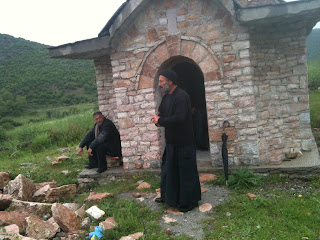
At the end of a long stretch, and at the foot of the mountain where the monastery is, we arrived at the old, unused church of St. Athanasios. Fr. Demetri had a key so we all went inside and venerated. It’s about the size of an HC/HC dorm room. No iconostasis, but just icons on the wall and an Altar built into the tiny apse. The original church was bigger and dated from the 10th century, if I remember correctly. I don’t remember when this newer, smaller one was built, but it was still pretty old!
We left the horses outside St. Athanasios and began our steep ascent to the monastery of Ss. Peter and Paul.
The monastery is magnificent! It was not used by the communists for other purposes because it is so out of the way. The frescoes are old and not in the best shape but are still intact. They are magnificent! Outside underneath the dome right outside the door is an icon of the Κόσμος (world) figure from the icon of Pentecost, along with signs representing either the twelve months of the year, or the signs of the Zodiac, or both simultaneously (we weren't sure), around him. Around the dome are a few scenes from the life of the Prophet Elias (among them is him beheading the false prophets!). A lot of other awesome icons were around the dome too, and on the wall, but I don’t remember much else. Hopefully people took pictures and can send them to me! There was some defacing and graffiti over the icons but you could see most of them.
Inside the church I think some of my favorites were the Akathist Hymn – frescoes of each stanza – as well as Enoch and Elias (who never died) being slain by the antichrist – a prophecy of the end times when they will return and be martyred (I actually didn’t see this icon but Aaron took a picture and I saw it on his phone). My favorite was probably the icon in one of the small domes right inside the door of the hymn to the Theotokos from St. Basil’s Liturgy, “In thee, O Full of Grace, all creation doth rejoice.” I had never seen an icon of this hymn before. This was one of the most detailed icons I’ve ever seen. It had the Theotokos, I believe by herself, in the center of the dome. Around her was written “Επi σοὶ χαίρει, Κεχαριτωμένη, πᾶσα ἡ κτίσις – In thee, O Full of Grace, all creation doth rejoice.” Then below her in one section of the upper part of the dome was a choir of angels, and also a choir of people, mainly ascetics. Underneath each of these was written, “Ἀγγέλων τὸ σύστημα – the company of angels and “ἀνθρώπων τὸ γένος – the race of men,” respectively. There was also a choir of holy virgins, underneath which was written, “παρθενικὸν καύχημα – boast of virgins.” Then it had an icon of the Annunciation, underneath which was written, ἐξ ἧς Θεός ἐσαρκώθη – from whom God was incarnate,” and an icon of the Nativity of Christ, where was written καὶ παιδίον γέγονεν – and became a child.” I don’t remember what icon it had for “τὴν γὰρ σὴν μήτραν θρόνον ἐποίησε – He made thy womb a throne,” or for καὶ τὴν σὴν γαστέρα πλατυτέραν οὐρανῶν ἀπειργάσατο – and he made thee more spacious than the heavens.” It’s not the whole hymn, and some of it had faded with time so I’m sure in its prime it was unbelievably more gorgeous than it was when I saw it, and more complete! I was still blown away!
The iconostasis, Fr. Demetri told us, is beautiful and is in a museum in Tirana, I believe. Right now they just have basic wooden boards with big hand-painted icons attached to them, and red curtains over the middle and side entrances to the Altar.
We chanted some hymns inside and then went out to the little chapel that was built over the monastery ossuary. The chapel is small, and very low – a tiny bit bigger than an HC/HC dorm room, and the ceiling is several feet lower. It too is covered in frescoes. It is so small that the Altar is built into the apse, and on the front of the Altar is a whale spitting up the Prophet Jonas. The iconostasis also is small – one or two icons on each side, I don’t remember, and only one side door (curtain) on the north side.
In the tiny narthex is a staircase going down to the ossuary. It is very dark down there – no lights, just a small window underneath where the Altar is upstairs. There are a lot of skulls lined up on shelves on either side of the room, and a lot of other bones in a big square area underneath the Altar area. I tried to think of each of these skulls as having skin – and probably a beard and a robe and a hat, since it was a monastery ossuary. Each of these bones belonged to a monk with a story, a life, and a history in the monastery. Who were the bishops? The priests? The deacons? The monks? The novices? The righteous? The sinners? The watchful? The negligent?
None of the clergy came down. I would have asked to do a Trisagion service. I chanted the four troparia of the Trisagion, “Among the spirits of the righteous,” etc. by myself, and then went up the stairs again.
Visiting all these old churches covered in iconography – I keep thinking of the iconographer. Who was he? What is his story? Additionally, in the two monastery churches – the katholikon and the chapel above the ossuary – with all the iconography, I kept thinking of two friends from school (the Romanian and the Puerto Rican), both of whom love iconography and would have been floored by the wonderful frescoes!
After visiting the chapel and the ossuary, Stelio and I went back inside the main church with Fr. Demetri, who talked to us a bit. Stelio took a few pictures. Finally we rushed out because we realized we were lingering too long. It is a pretty long road down the hill but Fr. Demetri knew a shortcut – right down the steep side of the mountain, through the short brush, bypassing the road. It is not a route I would have normally taken, but we were in a hurry. If Fr. Demetri could do it in his cassock – and he is at least 25 years older than I – we could definitely do it in pants!
We got to the bus where everyone was waiting for us (outside St. Athanasios). We all piled into what became a very dirty-smelling bus with all the rain and mud on us. We drove to a trout farm to eat lunch – His Eminence’s treat!
Our problem with having walked in the rain was that my change of clothes in my backpack was wet. Most other people had the same problem. It was still clean, and it wasn’t as soaked as the clothes I was wearing. But it was still pretty wet. I don’t remember what order I did these in but I did all of them – hung clean clothes by the outdoor fireplace/oven to dry a bit; stood by the oven myself to dry a little bit; used the bathroom; changed; stood by the fire some more. Then we ate! Standing by the fire we were all steaming because we were so wet! I was also worried about my books - prayer book, Psalter, bible, Abp Anastasios books for class - but aside from a little water on the edges of some pages, they were fine. They were not ruined, thank God! :)
The trout and all the trimmings were delicious! Again we took leftover berek to be consumed later.
A little bit dryer, our stomachs satisfied, we drove back to Korça, to the Metropolis. Ladi showed us our rooms in the Metropolis guest house. Three of us had a nice room on the third floor. Some others had typical grill spaceheaters in their rooms which they put their wet clothes on and put their shoes next to, to dry out.  Our room was a bit more of an adventure :) We had a gas disc heater, complete with the safety features of a big natural gas tank, a hose, two knobs and a cigarette lighter (notice the sarcasm). One of my roommates first figured out how to flush the toilet: the tank had to be filled with a metal hose coming out of the wall, and then you had to put your hand in the tank to lift up the “doo-hickey” to flush the toilet. Then he turned his attention to the heater. He figured out how it worked and then decided that we needed a lighter. We searched for one in the kitchen to no avail (Nathan exclaimed, “does no one smoke around here?!”). When the military man overheard what we were doing he said matter-of-factly, “do you need a lighter?” “Yes!!” we exclaimed. He had one that was wet from the walk. We set it by another room’s spaceheater for 20 minutes to dry out, and then took it upstairs. We lit it close to the disc and then slowly turned the gas on. The heater lit up and we turned the lighter off. Then we noticed that there was a lighter sitting on the bookshelf above the heater. We felt stupid.
Our heater, while more rustic, proved much more efficient than anything else. My shoes were soaked and wringable. Normally it takes them three days to dry out. By the next morning they were the tiniest bit damp. Good thing because I didn’t have another pair of shoes!
The shower was also interesting. No curtain. That seems to be a European thing. It has a shower hose that sprays water that detaches from the wall. I’m not an expert at showering European-style so I managed by getting wet, soaping up, and rinsing off. I don’t know how the Albanians do it :)
Some people went out around 5:00 to see the city and buy things. I took my still-soaked shoes and went to the cathedral at 6:00 for Vespers, but although it was scheduled it didn’t happen. They told me that one priest was in a meeting with some people and another was sick, so there was no Vespers. Oh well. The church was gorgeous! It’s very new (relatively speaking), and is about 2/3-3/4  covered in brilliant iconography! A lot of people took pictures the next day which I hope to share eventually! The chandelier was massive. Wood! The bottom layer was either as big or bigger than the chandeliers at Holy Trinity in Ambridge PA, or at Ss. Cyril and Methodios at Camp Nazareth. But there were about four layers. As they went up they got smaller but just as intricate!
I left the church around 6:20 and came back to the room where one roommate was asleep. The other was out. I put my shoes and socks back on chairs in front of the heater, along with most of the clothes we all weren’t wearing. A little after 7:00 the rest of the group went out for dinner. I didn’t go with them for several reasons: 1) my shoes weren’t dry; 2) I wanted to stay in the room so that the heater could stay on and more clothes could dry. We had already decided that it was too risky to leave unattended; 3) I wasn’t too hungry. I had some of the berek from earlier and was fine; 4) I didn’t want to be out too late – I was tired and wanted to get some reading done and go to bed early.
Well, I didn’t make the best use of my time. I opened up a picture book about Albania that happened to be sitting in the room and perused it for probably 45 minutes. Unfortunately I couldn’t work on my blog because I had fortunately left my computer in Tirana. If I had brought it, it may have been ruined on the hike. I did very little catch-up reading for our missions class (three pages, maybe?). At first I tried to keep the heat in but then realized that it got way too hot and way too dry to do that so I opened the balcony door, the inside door, and the hallway window to get a cross-breeze. It was a little more bearable that way. I put up with the heat and dryness because I knew our clothes needed to dry :)
The others took forever to get back. The Italian/Russian couple came back around 9:30 or 10, I believe. Some others went to an internet café and to go get dessert, I think. Finally around 11:15 I decided to go to sleep. Most of the clothes were mostly dry so I turned off the heater, straightened the room a little, left Stelio a note of the status of the clothes and what time I wanted to get up, and turned the light out.